Safeguarding
Safeguarding Vision
Safeguarding and promoting the welfare of children is defined as:
- protecting children from maltreatment,
- preventing the impairment of children’s mental and physical health or development,
- ensuring that children grow up in circumstances consistent with the provision of safe and effective care, and
- taking action to enable all children to have the best outcomes.
Brunel School fully recognises the responsibility we have to safeguard and promote the welfare of young people in line with Keeping Children Safe in Education 2026.
Brunel School will establish an outstanding safeguarding culture where every pupil is safe, every voice is heard, and every adult takes responsibility for protecting and promoting the welfare of young people. Through trauma-informed, relationship-based and contextually informed practice, we recognise the complex interaction between safeguarding, vulnerability and SEMH needs. We are committed to understanding the experiences, environments and relationships that shape our pupils' lives, ensuring that they feel safe, valued and empowered both within and beyond the school gates. Through effective multi-agency collaboration and a focus on wellbeing, we will equip our learners with the confidence, resilience, self-regulation and life skills needed to thrive, make safe choices and achieve successful futures.
Intent
At Brunel School, safeguarding is the foundation upon which learning, wellbeing and personal development are built. We recognise that many of our pupils have experienced trauma, adversity, disrupted attachments and other experiences that may impact their social, emotional and mental health. As a result, we understand that vulnerability cannot be separated from SEMH needs and that behaviour is often a communication of unmet need rather than a choice.
Our intent is to create a culture where safeguarding is proactive, relational and embedded in every aspect of school life. Through a contextual safeguarding approach, we seek to understand not only what is happening to a young person, but also the influence of their peer groups, family circumstances, online activity, community experiences and wider social environments.
Impact
The impact of our safeguarding culture will be evident when pupils experience safety, belonging and success both within school and in the wider contexts of their lives.
We will know our vision is being realised when:
- Pupils report that they feel safe, listened to, understood and supported.
- Pupils develop increased emotional literacy, self-awareness, resilience and self-regulation.
- Safeguarding concerns are identified early through strong relationships and effective professional practice.
- Staff consistently understand and respond to behaviour through a trauma-informed and contextually informed lens.
- Risks associated with exploitation, peer influences, online harm, community-based harm and other contextual safeguarding concerns are recognised and addressed effectively.
- Pupils demonstrate improved engagement, attendance, wellbeing and readiness to learn.
- Families and external agencies work collaboratively with the school to support positive outcomes.
- Pupils are equipped with the confidence, knowledge and skills to keep themselves safe, build healthy relationships and navigate challenges successfully.
- Vulnerabilities linked to SEMH needs are understood, supported and reduced through targeted intervention and effective multi-agency working.
- Safeguarding is recognised as a strength of the school, with a culture where every adult takes responsibility and every young person is empowered to thrive.
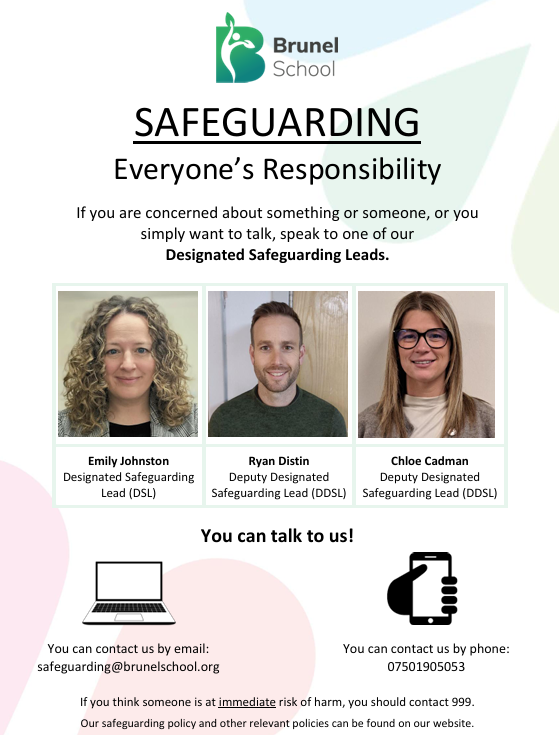
Our Safeguarding Team
Our Safeguarding Policies
Click here for our safeguarding policies, including our attendance and online safety policies.
You can also find further safeguarding information, including our Child-Friendly Safeguarding Policy and our Safeguarding leaflet, at the bottom of the page.
Operation Encompass
Brunel is an Operation Encompass School.
Operation Encompass is a police and education early information safeguarding partnership enabling schools to offer immediate support to children experiencing domestic abuse.
Operation Encompass ensures that there is a simple telephone call or notification to a school’s trained Designated Safeguarding Lead/Officer (known as key Adult) prior to the start of the next school day after an incident of police attended domestic abuse where there are children related to either of the adult parties involved. This sharing of information enables appropriate support to be given, dependent upon the needs and wishes of the child.
Children are negatively impacted by experiencing domestic abuse and without early intervention and support this negative impact can last through a child’s life course. Domestic abuse can impact upon social, psychological, physical, emotional and behavioural outcomes with an often negative impact upon a child’s academic success. Experiencing domestic abuse has been identified as an Adverse Childhood Experience.
Operation Encompass aims, by directly connecting police and schools, to secure better outcomes for children , to enable schools to better understand the impact living with domestic abuse has upon children, to help schools to better understand a child’s lived experience and to therefore be able to support and nurture each child, making a child’s day better and giving them a better tomorrow.
We are sharing information in line with the operation encompass agreement.
Information for Pupils
If you think you or someone you know is being abused, or neglected, or have any safeguarding issues that you would like to report, or simply get some advice on, you can speak to the DSL or any other member of staff. All our staff have relevant training and will know the steps they need to take to help.
Student Safeguarding Useful Links
- Young Person's Guide to Keeping Children Safe
- Young Persons Guide to Working Together to Safeguard Children
- External Agency Student Support
- YPI General Leaflet
- What Makes up a Good Relationship?
Information for Parents & Carers
Brunel School works with many other organisations and agencies to support and safeguard the young people with whom we work.
We use a system called CPOMS to log and record incidents or concerns relating to safeguarding. CPOMS supports our school's processes to monitor child protection, safeguarding, pastoral and welfare concerns for pupils.
If you are worried about yourself or someone else, the following links may be useful in directing you to an organisation that can help:
- Barnardos
- Childline
- NSPCC
- YPI Counselling
- Torbay Safeguarding Children Partnership
- Plymouth Safeguarding Children Partnership
- The Devon Safeguarding Children Partnership (Devon SCP)
Online Safety
Tips for helping children stay safe online - IWF / PIER
‘Self-generated’ child sexual abuse material (CSAM) has been the subject of research that PIER (Policing Institute for the Eastern Region) have just finished on behalf of the Internet Watch Foundation. ‘Self-generated’ CSAM are images and videos which are taken by children and then shared either:
- willingly, usually with a boyfriend/girlfriend, or
- unwillingly, through coercion, or
- shared by a third party without their consent.
Some of these images end up being distributed, sometimes sold, on the open and dark web by those with a sexual interest in children.
Just over 300 children took part in the research and talked about their experiences of growing up in a digital world, where they talk to their friends, game and do their schoolwork online. Many described receiving unwanted sexual images and some commented that it has become normalised and part of their lives. The apps they use, such as Snapchat and TikTok are also used by perpetrators to talk to children and groom them into sharing sexual images. This is a serious safeguarding issue, with wide-reaching consequences that we all need to learn more about.
PIER and IWF have written a blog post for parents about how they can better understand their children's online world and its risks. The blog post can be found here: https://www.iwf.org.uk/news-media/blogs/tips-for-helping-children-stay-safe-online/
See below for more useful documents, websites and posters regarding keeping your child safe in the online world.
-
CEOP News and articles surrounding internet safety.
-
Think You Know Great advice to keep children safe whilst using the internet.
-
Parent Information Expert information to help children and young people stay safe online.
-
UK Safer Internet Centre E-safety tips, advice and resources.
-
NSPCC Online Safety Helpful advice and tools you can use to help keep your child safe whenever and wherever they go online.
-
Childnet International Parents and Carers information to keep your child safe online.
-
Online Safety App Keep up with the latest apps games and tech your children are using, with the worlds most comprehensive online safety app for parents
-
Internet Matters Internet and social media advice for parents
CEOP Education: Helping Children Stay Safe Online
CEOP Education — part of the National Crime Agency — provides resources, advice and support to help children and young people (aged 4–18) use the internet safely. With age-appropriate films, animations, lesson plans and guidance for parents and carers, CEOP helps families and professionals talk about difficult topics like online risks, exploitation and abuse — making the digital world safer and more enjoyable for children.
CEOP’s Safety Centre provides a way for children, parents and carers to report worries about online sexual abuse or exploitation. If a child feels unsafe — for example, someone is asking for sexual images, pressuring them to talk about sex, or making them uncomfortable online — they can make a report through CEOP’s online form, which is reviewed by trained Child Protection Advisors. These advisors assess the situation, contact the reporter, and decide what steps are needed to help keep the child safe, often working with local police or safeguarding services. Reports can be made by children themselves, parents, carers or professionals, and the service is designed to offer support, protection and guidance whenever something doesn’t feel right. If a child is in immediate danger, families should call 999.
For further information, please visit: www.ceopeducation.co.uk/
Young Carers
Our action plan for supporting Young Carers at Brunel School can be found below.
Report a Safeguarding Concern
Worried About a Child?
If you are concerned about the safety, wellbeing or welfare of a pupil, please tell us. Safeguarding is everyone's responsibility, and sharing a concern could help keep a young person safe.
During School Hours
Please contact a member of our Safeguarding Team:
Designated Safeguarding Lead (DSL): Emily Johnston
Deputy Designated Safeguarding Leads: Ryan Distin and Chloe Cadman
☎ Telephone: 01803 665522
✉ Email: safeguarding@brunelschool.org
Alternatively, concerns can be reported in person via the school reception.
What Should I Report?
You may wish to contact us if you are worried about:
- A pupil's safety or welfare
- Neglect or abuse
- Changes in behaviour, emotional wellbeing or mental health
- Bullying, peer conflict or exploitation
- Online safety concerns
- Attendance concerns
- Risks within the community, peer groups or family environment
Outside School Hours
If your concern cannot wait until school reopens, please contact:
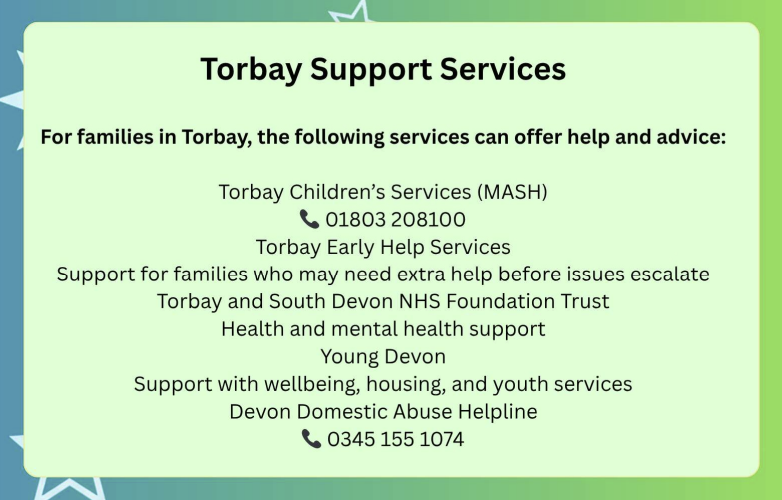
Torbay Multi-Agency Safeguarding Hub (MASH)
☎ 01803 208100
Emergency Duty Team (Out of Hours)
☎ 0300 456 4876
Immediate Risk
If a child or young person is in immediate danger, always call 999